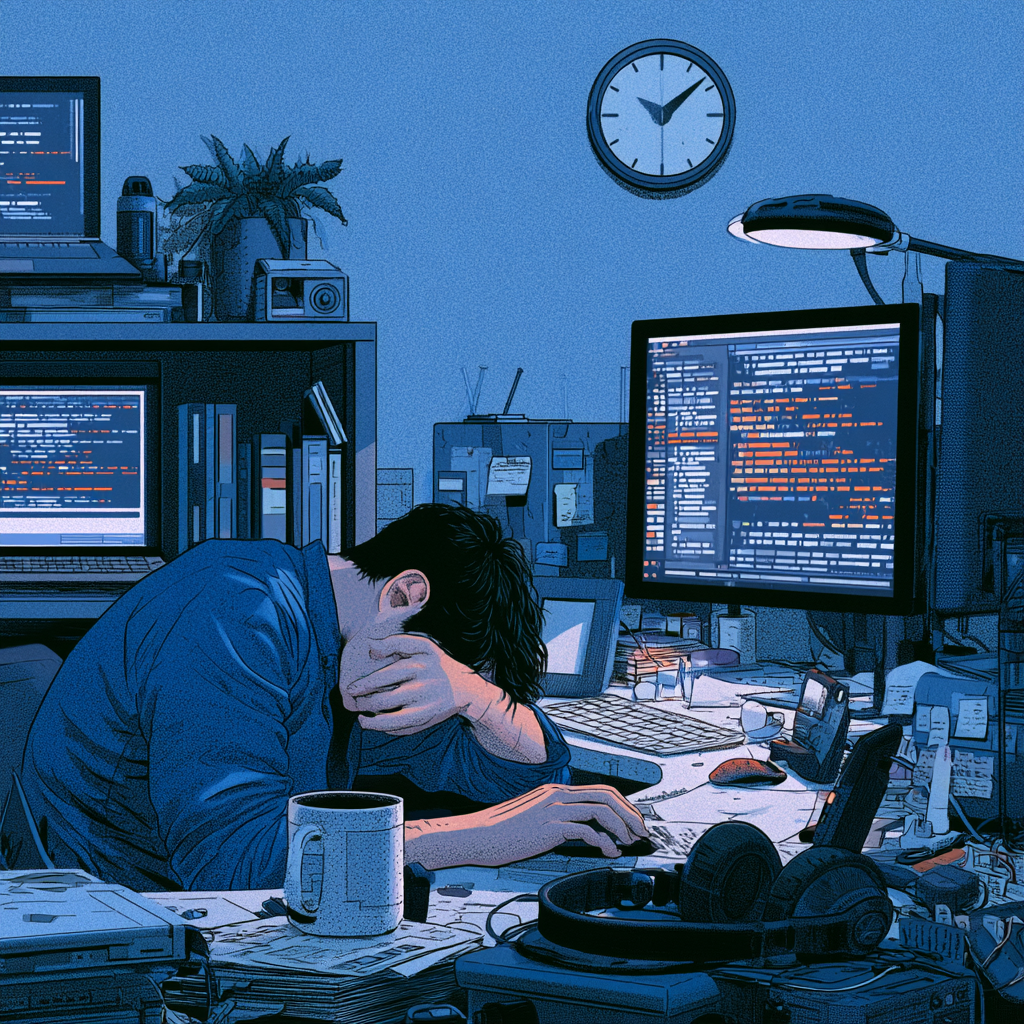
 Software Exhaustion Is Real
 Written on August 12, 2026 by ΞVΞ ⁂
Tags: AI, claude, claudeai, mental health, software, stress, tech
I’m writing this on the heels of being suspended from Claude.ai for an unknown reason that they themselves haven’t provided me, which I believe is just a false-positive. I don’t do anything Neo Anderson-level with Claude as I only had Pro for 11 days, only used Claude Code once, and consider myself just above a beginner. But I’ve spent my entire life working as a technical support specialist, so I still spend a lot of time fixing and customizing technology.
As a result, I have been trying to setup an invisible workflow between my subscriptions so they seem seamless. But unfortunately, technology itself has prevented me from doing this, because of their constant hiccups, glitches, and suspensions by their aggressive bots over inane stuff, then I have to wait weeks for a human to fix it, and it’s stressing me out. Hell, even when Gmail was new, my Google account was getting banned almost every month for unknown reasons.
I do a lot with software. Streaming tools. Social platforms. Websites. Bots. Video tools. Games. Account dashboards. APIs. Moderation systems. Browser extensions. Password managers. Automation. The list keeps growing because every service promises to make something easier.
And sometimes it does—until it doesn’t.
I call the feeling that builds up afterward software exhaustion.
It is not just being annoyed when an app crashes. It is the slow mental wear of needing to constantly maintain the systems that are supposed to help you work, create, communicate, or relax. Every day seems to bring a new issue: an update changed a setting, an integration stopped working, a platform altered a policy, an account got flagged, a security system produced a false positive, or a tool that was part of your routine suddenly became inaccessible.
You don’t get to simply use the thing. You have to become its support department first.
For someone who works online, makes content, streams, and builds custom tools, this can become relentless. A streaming setup is not one program. It is a collection of platforms, scenes, sources, audio devices, plug-ins, chat systems, alerts, encoders, accounts, and network connections. A single failure can mean troubleshooting several layers before you can even begin the work you intended to do.
The frustrating part is that technical skill does not remove the exhaustion. Sometimes it makes it worse.
If you know how to troubleshoot, you can see ten possible causes for every problem. You know there may be a fix somewhere in a log file, a Discord thread, a GitHub issue, an obscure settings menu, or a support ticket. So instead of being able to walk away, you feel pressure to investigate. You can probably solve it eventually—but that does not mean you have the energy to solve it today.
Account suspensions and automated security systems add another kind of stress. There is something uniquely demoralizing about being blocked from a service you were using normally, then having to spend days or weeks proving that you are allowed to use it. You may have done nothing wrong, but you still have to document, appeal, wait, follow up, and hope a human reviews the situation. A ban over here, a suspension over there, false-flag b lock in the back, another account on hold in the front. The frustration of daily tools, breaking in one way or another puts a mental toll on you.
Meanwhile, the workflow you built around that service is broken.
They could care less about fixing your issue quickly. They have endless pools of US monopoly money from investors, and millions of other “people “customers” they roll in and out learning the same lesson.
Software exhaustion is partly about the volume of failures, but it is also about the loss of trust. It becomes difficult to adopt a new tool when you expect that it will eventually break, change ownership, raise its price, remove a feature, or lock you out. What should feel like progress starts to feel like adding another fragile dependency to your life.
I do not think the answer is to stop using technology entirely. It is too embedded in work, community, creativity, and everyday life. But I am trying to treat reliability as a feature worth prioritizing. Sometimes the simpler tool is better. Sometimes a local file is better than another cloud service. Sometimes the best decision is to avoid an integration that will create more maintenance than value.
And sometimes the right response to a broken system is not to fix it immediately.
It is okay to make a note, close the tab, and come back later. It is okay to choose a workaround. It is okay to remove a tool from your workflow if it keeps demanding more energy than it returns.
With all the tools we’re given, my concern is that now it all breaks consistently. Sure I can fix it, but I don’t want to keep having to fix things or running to other software. Technology is supposed to support our lives. It should not require us to be permanently on call for it.

Reposts